- Founder Weekly
- Posts
- Founder Weekly (Issue 746 August 26 2026)
Founder Weekly (Issue 746 August 26 2026)

Rahul Chaudhary
August 26, 2026
In partnership with

Welcome to issue 746 of Founder Weekly. Let's get straight to the links this week.
The AI Work Handbook That Cuts Your Workday in Half
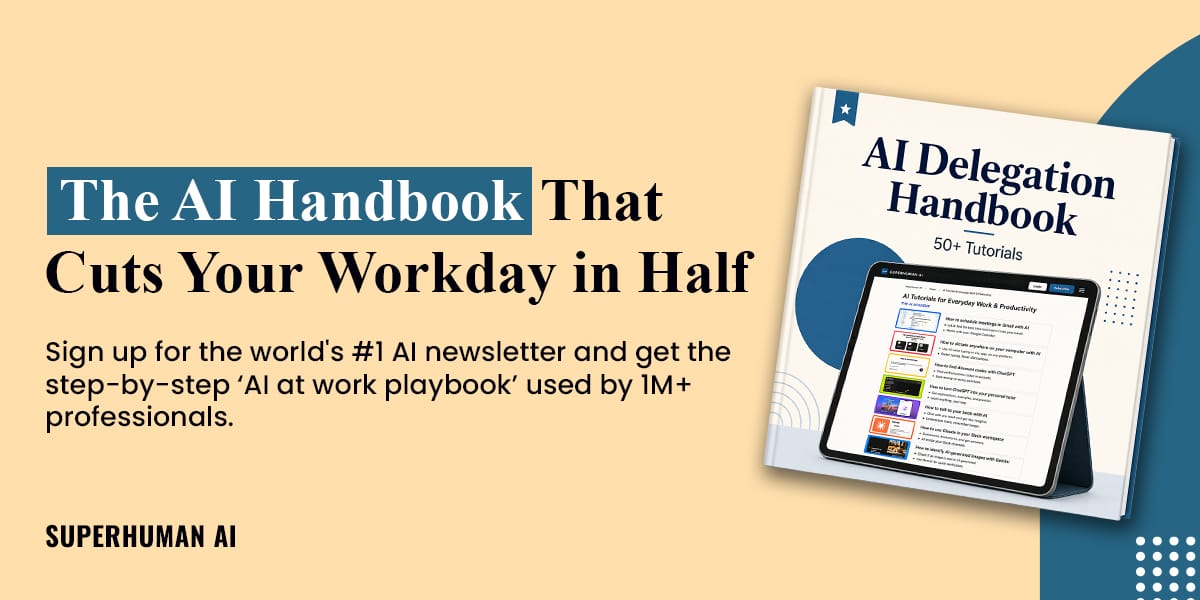
The 8-hour workday is becoming a 4-hour workday for people who know how to use AI.
Everyone else is still catching up.
This AI work playbook shows you exactly how to cut your work hours in half using AI.
Sign up for Superhuman AI and get:
50+ step-by-step AI tutorials to cut your workload in half — covering every part of your workday, from emails to strategy, used by 1M+ professionals at Google, Microsoft, and NASA
Superhuman AI newsletter (4 min daily) so you keep discovering new AI tools and skills to stay ahead in your career — the playbook is just the start
General
Tech founders and VCs are spending more time online as AI accelerates the pace of change, using Tech Twitter to track trends, build distribution, stay connected, and understand what the ecosystem cares about. But the constant stream of startup news and discourse comes with tradeoffs, raising questions about whether being perpetually online provides a real competitive advantage or simply damages focus and sanity.
The race for the AI application layer is not only about UI, workflows, or GTM... it is a fight for the intelligence layer itself.
Gilt Groupe’s story offers startup lessons on building an exclusive brand, creating memorable customer experiences, launching quickly, listening to customers, and driving growth through word of mouth. Other takeaways cover fundraising, hiring, keeping engineering in-house, killing unsuccessful products quickly, and why growth without profitability can ultimately undermine a business.
AI governance is now a fiduciary obligation. We break down what 'chain of custody' actually means in practice, and a seven-point action checklist you can bring to your next board meeting.
AI has made software much cheaper to build, but the long-term costs of maintenance, security, compliance, and ownership have not disappeared. The piece offers a practical build-vs-buy framework centered on blast radius, ownership cost, differentiation, and whether you have a clean exit path if a better third-party option appears.
Marketing, Sales and PR
Jen Abel breaks down the full enterprise sales cycle into roughly 15 steps, from landing the first meeting and running discovery through pilots, pricing, procurement, redlines, and signature. The conversation covers practical tactics such as the “pincer model” for outreach, concise messaging that offers buyers “alpha,” and tightly structured pilots designed to build momentum toward a deal.
Lovable’s first designer shares how the company found its core audience, launched before the product was perfect, and shaped its brand around the emotions users experienced with the product. The story shows how extreme ownership, rapid decision-making, constant user feedback, and a high “clock speed” helped Lovable reach $100M ARR just eight months after launch.
The must-knows for building and running GTM in 2026.
Money and Finance
Capital is abundant, but concentrating into fewer companies as the bar for what qualifies as venture-scale keeps rising.
The post explains the VC math behind why fundraising gets harder at each successive stage, including how required outcomes change as valuations rise, why $1M ARR may not be enough for a Series A, and why a solid business may still not fit venture economics. It also gives founders practical options when they hit a fundraising wall.
For AI company acquisitions, traditional financial and SaaS diligence (ARR, growth, etc.) is insufficient because many “proprietary AI” products are just thin wrappers around third-party models, such as a system prompt, API call, and UI. Inspect the actual codebase and score risks like model dependency, data provenance, talent concentration, and substitution risk before signing, otherwise you risk overpaying for non-defensible tech.
Our Other Newsletters |
Python Weekly - A free weekly newsletter featuring the best hand curated news, articles, tools and libraries, new releases, jobs etc related to Python. |